

The following code letters are employed in gem certification in order to indicate the nature of any treatments that may have been applied to the gemstone to enhanced its colour, appearance or durability.
N – Indicates a gem that is in its natural state with no enhancement. Gems that are seldom if ever subjected to enhancement include most members of the garnet family, peridot and spinel.
E – Gems in this group are routinely treated. This includes aquamarine (heated to remove greenish element), citrine (often derived by heating amethyst), onyx (blackened by sugar and sulphuric acid treatment) and tanzanite (heated to remove brown element).
ASBL – A stone that has been assembled from two or more pieces for example garnet-topped doublets, opal doublets and triplets.
B – Chemicals have been used to bleach or remove the gemstone’s colour. It should be noted that marine pearls are generally bleached to remove a prevalent greenish element.
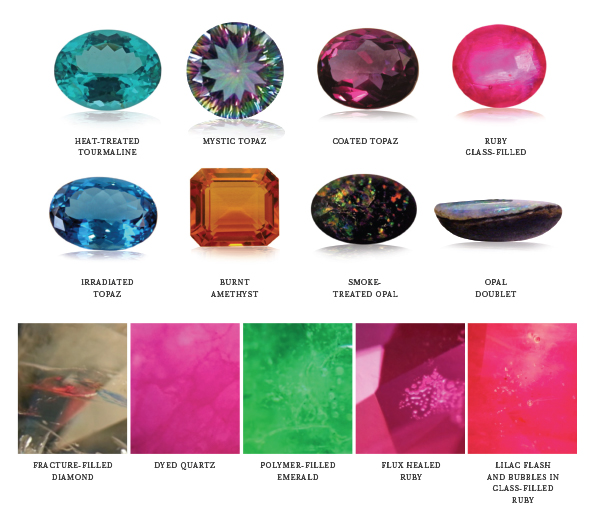
C – Films or coatings have been employed to improve the stone’s appearance. Mystic topaz, aqua-aura quartz (gold).
D – A coloured dye has been used to improve the existing hue of a stone or give it a new colour. Lapis-lazuli, quartz etc.
F – This indicates the presence of solidified flux or similar colourless substances visible under proper illumination and 10x magnification. e.g Fracture-filled diamond. Look for flash effect (see image), flux-healed ruby etc.
H – Heat has been employed to alter colour, clarity or phenomena. Residues not visible when properly illuminated and examined under 10x magnification. Ruby, sapphire, Paraiba tourmaline etc.
H(a) – Insignificant residues detected.
H(b) – Minor residues detected.
H(c) – Significant residues detected.
H(d) – Lead glass filled e.g. Frequently encountered in ruby. Look for lilac flash and bubbles in transmitted light, spider-web appearance of exposed glass filled fractures in incident light.
I – Intentional filling of surface reaching cavities to improve durability, appearance and/or weight. Polymer filling of emerald
L – Use of a laser and sometimes chemicals in order to reach and alter inclusions. This process is frequently employed with diamond.
O – Filling of surface reaching cavities with a colourless oil or similar substance to improve appearance. Emerald
R – Irradiation employed to alter a gemstone’s colour. Morganite, diamond, spodumene, topaz.
U – Diffusion, this method employs chemicals and high heat to introduce an ultra-thin layer of colour. This treatment is most frequently encountered in sapphire.
W – Waxing of lapis lazuli, turquoise etc.
