

Akoya Cultured Pearls
The bivalve molluscs that produce the majority of pearls are frequently and inaccurately referred to as oysters.
They are actually ‘wing shells’, a genus that builds an attachment by the hinge and can open and close both shells.
Wing shells occur in a range of sizes from the small 6cms Pinctada Radiata of the Persian Gulf to the huge 30cms Pinctada Maxima of the South Seas.
The process of producing a completely round cultured pearl was first accomplished in Japan using the wing shell Pinctada Fucata. This is a mollusc that is widely distributed throughout the Persian Gulf, Red Sea, China, India, Japan, Korea, Venezuela and the
Western Pacific.
The Akoya molluscs are very vulnerable to changes in water temperature. While variations above 280C or below 80C can be fatal low temperatures are favourable to the quality of the pearls produced since the platelets that are deposited are smaller, denser and brighter.
Pearl farmers are very conscious of this so they time the lifting of the Haamage (pearl crop) when the lustre of the pearls is at its best. Relatively few Akoya pearls achieve 8mm in diameter. The operation to introduce the mother-of-pearl bead together with a section of mantle tissue often produces small centres of irritation.
The animal also coats these with nacre thus creating the tiny pearls that the Japanese call Keshi or poppy seed pearls.
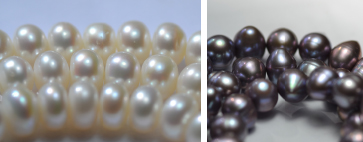
Left – Akoya pearls
Right – Irradiated, belted Akoya pearls
Freshwater Pearls
As much as 3000 years ago the Chinese were using Cristaria Plicata, a species of freshwater mussel, to coat religious objects with nacre.
The process they employed involved using a bamboo spatula to ease the animal’s mantle away from its shell while they inserted small lead images of Buddha. It took several years for these religious images to accumulate a substantial coating of nacre.
During the period from 1911 to 1925 Japanese pearl farmers undertook a series of experiments in Lake Biwa employing the same large freshwater mussel Cristaria Plicata (Unio). The species is of wide occurrence in the rivers and lakes of Japan. They did not use a mother-of pearl nucleus to create these Biwa pearls.
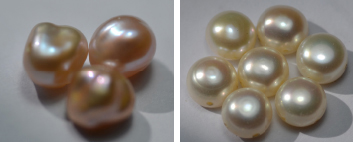
Left – Lake Biwa freshwater pearls
Right – Biwa, freshwater button pearls
A series of incisions were made in the large mantle lobe of the mussel and small segments of tissue cut from the outer lip of another mussel were inserted.
The transplanted tissue, that carried the functions of shell building, rapidly grafted into place and began to secrete layers of nacre that eventually formed
a pearl.
The shape of the resulting pearl was governed to some extent by the form of the original segment of tissue. Smoothly rounded, lustrous and exhibiting a wide range of natural hues the Biwa pearls were very beautiful and rapidly developed a substantial market.
Pearl farmers in China countered, resorting to mass production methods so that they could compete on the basis of cost. Their product, bearing a remarkable resemblance to rice crispys in shape, was bleached then dyed in various artificial colours.
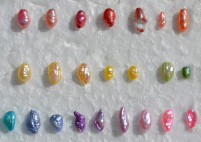
China, freshwater ‘rice-crispy’ pearls
Fortunately production has come a long way since those early days and large attractive freshwater pearls in a wide range of hues are now available at very competitive prices.
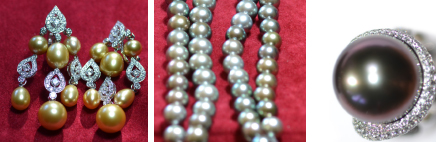
Left – Golden-lip Pinctada Maxima Indonesia
Middle – Graduated South-Sea Pearls. Pinctada Maxima Cook Island
Right – Tahitian South-Sea Pearl, Pinctada Margaritifera
South-Sea Pearls
Marine pearls, usually 10mm or more in diameter, are termed South-Sea Pearls.
Very large wing-shell molluscs, for example, Pinctada Maxima or Pinctada Margaritifera are employed to produce them.
Pearls are also recovered from members of the conch family. While conch pearls do not have a nacreous coating they do enjoy a ready market because they frequently exhibit attractive hues especially in a range of pinks.

Co-authored by Arthur Thomas FGA(GB), GG(USA), CE(RSA)
and Craig Thomas FGA(GB), GG(USA), B.Comm(RSA).