


Historically, diamonds were known as the Indian Stone, since India was believed to be the only true source of diamond. When Portuguese explorers discovered diamonds in Brazil they found that they could not market them because they did not originate from India.
They overcame this by shipping the stones to Goa, a Portuguese enclave in India. From Goa they were shipped to Amsterdam, the major diamond cutting centre at that time, where cutting works now accepted them as originating from India.
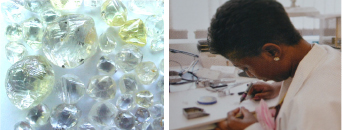
Left – Diamond rough
Right – Diamond Marker
Diamond was termed “adamas” or “unconquerable” because of its hardness. A rough octahedral point diamond mounted in the handle of a sword was believed to transfer this power to its owner.
Rough diamonds received by a diamond cutting works are checked, weighed, and entered in the diamond register. They must then go to the marking room for analysis and marking.
Depending on its crystal shape and nature a stone may be made as a single stone, sawn or lasered to produce two stones or sectioned by cleaving.
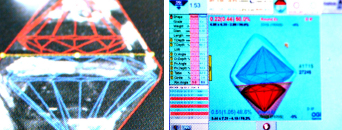
Left – OGi Video
Right – OGI Unit
Imaging technology has had a profound effect on the assessing of rough and the recoveries achieved. A stone is centred on a cylindrical rod and filmed as the rod rotates. Once the video has been captured the marker can view the stone from any angle while the program outlines potential within the image on screen. The marker can rotate the combined images and check the fit from every angle.
Diamonds have a grain and this means that it is only possible to work them in specific directions. They can only be sawn in the cube plane and will only cleave parallel to an octahedral face.
Makeables. Should the marker determine that a crystal should be cut as a single stone, termed a Makeable, she will mark the position of the table with a dot of Indian ink.
Sawables these are either simple or slightly modified octahedra that will be sawn in the cube plane. They are usually sawn off-centre to produce the largest possible stone and minimise the time and the material lost in sawing.
Cleavables. The disadvantage of cleaving is that it yields poor shapes and with the advent of the laser it is not widely used.
Bruting
The cutter or bruter is the workman responsible for rounding up the rough. He must secure the stone on a metal rod termed a dop then key it into the chuck of a lathe. He uses a second diamond mounted on a rod as a lathe tool to shape the stone rotating on the lathe.
Once the corners of this second diamond are sufficiently rounded it will in turn take its place in the lathe.
Polishing
A special heavy cast iron disc termed a scaife is employed to grind and polish the facets on a diamond. The surface of the scaife is scored with coarse silicon carbide grit to create the grooves that will help to retain the paste of diamond powder and olive oil used to polish the stones. A vertical spindle is housed in bearings above and below the scaife to ensure that it runs smoothly, free of any vibration when it reaches an operating speed of 2,500rpm. The craftsman uses a hand tool known as a tang to position and rotate the dop that is used to hold the diamond.
The Cross Worker
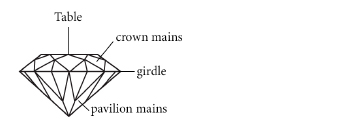
Cross working facets
The polishing process begins with the cross worker (blocker). He must open windows in the frosted stone so that he can examine it closely, visualize how the stone is oriented in relation to its grain and detect any inclusions.
The Table Plane. The grain involved when polishing is complex. In the case of the table facet the grain is diagonal and it is referred to as having a four point grain, corner to corner and from the left or right.
The Octahedral Plane. The octahedral plane is triangular in shape and it has a three point grain. It can usually be identified in irregular rough by the presence of recessed trigons in the octahedral face.
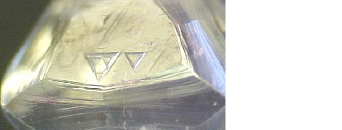
Trigons
Trigons are equilateral triangular, growth features that are reversed in respect of the octahedral face. An important aide to the cross worker when he is orienting a stone is that the side of a trigon will always face a point. Once he has oriented himself within the stone he may lightly block out the corners to create windows that will let in more light. This will make it easier for him to detect any fine inclusions under the table.
He will now place the corner, bezel facets and table on the crown, the corner and bezel facets on the pavilion and a culet if required.
The Brillianteer
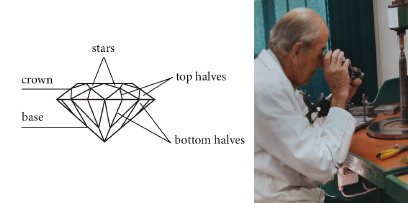
Left – Brillianteer facets
Right – Brillianteer
In a classic round brilliant the brillianteer places and polishes a further forty facets on the stone. These are the eight star facets around the table, sixteen crown halves and sixteen pavilion halves.

Left- Trigons
Right – Dodecahedral growth-lines
The dodecahedral plane has growth-lines that run from natural point to natural point. The dodecahedral grain runs perpendicular to these growth-lines.
Macles
A macle is formed by twinned diamond crystals. Macles generally exhibit a triangular tabular form. The twinning is on the octahedral plane with one crystal rotated through 1800. A herringbone seam running around the stone and base to base trigons are features that are typically found in macles.
It is essential to devote careful study to a rough macle before undertaking to block it, both because of its complex grain structure, and because of the numerous inclusions normally associated with this form of rough.
The Development of the Modern Brilliant Cut
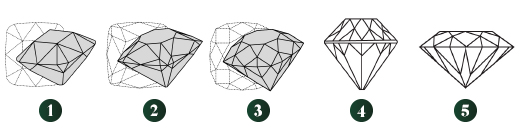
1 – Mazarin
2 – Peruzzi
3 – Old European
4 – Tolkowsky / American
5 – Modern Ideal Brilliant
Master craftsman Bazil Watermeyer’s innovative design, that he named the Barion cut, brought the fire and life of brilliant cutting to squares, rectangles and cushion cuts, shapes that were traditionally step cut. But this huge subject must await another article.

Co-authored by Arthur Thomas FGA(GB), GG(USA), CE(RSA)
and Craig Thomas FGA(GB), GG(USA), B.Comm(RSA).