

The Devil is in the Detail
What is synthetic moissanite?
Synthetic moissanite has become a popular addition to many jewellery ranges and is enjoying a rise in sales. And why not? It is beautiful, durable, and affordable – what’s not to love?
Synthetic moissanite is a lab-grown gemstone. It occurs in nature but only in minute amounts with crystals too small to be used in jewellery. Therefore, when selling a synthetic moissanite we must state that it is lab grown, or synthetic, to maintain transparency. It is the legal and ethical thing to do. In contrast, we don’t find Cubic Zirconia in nature, negating the need to disclose it as a synthetic as all Cubic Zirconia are lab-grown.
A small but essential detail, I’m sure you agree.
So, what’s the issue with synthetic moissanite versus diamond? Again, it’s all in the detail.
The first issue is when synthetic moissanite is compared with diamond, and further confusion is created when they are graded or described in the same language as one would a diamond. Let me elaborate.
Grading
The grading of a diamond is extremely strict and precise which, quite honestly if one had to grade a synthetic moissanite as a diamond we wouldn’t have many good quality synthetic moissanites around. We have seen certificates for synthetic moissanite that are misleading and incorrect by diamond standards. Using diamond clarity grade terminology for any gemstone other than a diamond is, in my opinion misleading. Just trying to compare colour to a diamond is also going to do harm to a synthetic moissanite.
Grading terminology
Using plain English so that everyone can understand would be the way to go. We use the ICSL grading system for all gemstones except diamond, which uses percentages and plain English.
Clarity terminology
Eye clean, very lightly included, lightly included, moderately included, heavily included
Colour descriptions for synthetic moissanite
Colourless, near colourless, slightly tinted, tinted. You also get the obvious colours.
Below is a table with the comparative properties of the two stones.
| Syn Moissanite | Diamond | ||
| Specific Gravity | 3.22 | 3.52 | Syn moissanite is lighter than a diamond |
| Refractive Index | 2.648-2.691 | 2.42 | Syn Moissanite is doubly refractive, diamond is singly refractive |
| Birefringence | 0.043 | NA | Obvious double refraction in syn moissanite |
| Dispersion of light | 0.104 | 0.044 | Syn moissanite has a higher dispersion of light to diamond |
Hardness
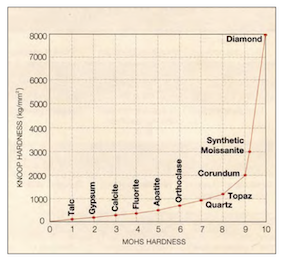
On the Mohs scale of hardness synthetic moissanite is actually closer to 9.25 to 9.5 where diamond is a 10. Going by the graph synthetic moissanite is actually closer to ruby and sapphire in hardness than diamond.
Optical properties
You cannot compare the proportions of synthetic moissanite to that of a diamond.
The optical properties are different, so cutting a synthetic moissanite to diamond proportions will block out light and not display its properties properly.
The critical angle of a diamond is 25 and synthetic moissanite 22, so the angles have to be cut differently to get the most out of it. (Click here for an explanation of how the critical angle works.)
To clarify:
Synthetic moissanite should not be compared to diamond as they are totally different in every way; a synthetic moissanite is an imitation or simulant of a diamond.
Let’s keep it simple!
Wouldn’t it be better for your sales to get an independent, unbiased report?
According to The World Jewellery Confederation (CIBJO) “…Do Not use language verbal or written that does not accurately and unambiguously reflect the true nature and/or condition of a product being described…”
Indeed, when it comes to our industry, it really is all about the details.
Kind regards
Jeremy